
Greek scales (dromoi)
Rast's reason for existing is in this page. If you have ever watched a Western chord detector stamp a Greek song as plain D minor when your ear hears something far more colourful, you know the problem.
What dromoi are
The dromoi (δρόμοι, "roads") are the modes used across Greek folk and urban music — rebetiko, laiko, dimotiko, nisiotiko. They are cousins of the Turkish makamlar and the Arabic maqamat. Some of them line up neatly with Western minor or major; many do not. A single dromos can have a flattened second, a raised fourth, an augmented step you would never see in classical Western theory.
The trouble is that mainstream key-detection software was trained almost exclusively on major and minor, so it tries to round every dromos to its nearest Western neighbour — flattening exactly the intervals that make the scale interesting.
How Rast handles them
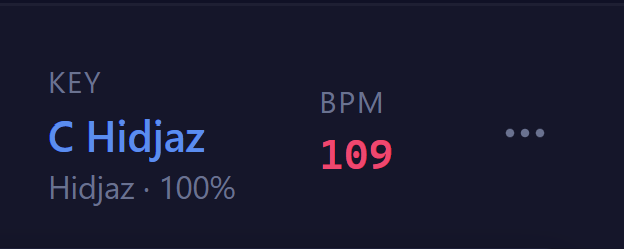
Rast's key-detection step knows all eleven dromoi. It looks at which chords appear and how the harmony moves — paying special attention to the tonic, the dominant, and any flattened second — then weighs the song's chroma fingerprint against each candidate scale. The result is the detected key shown in the song header and the sidebar (e.g. D Hidjaz).
You will see the same dromos influence the chord colours on the timeline: tonic, dominant, subdominant, and flat-second functions are coloured according to their role in the detected scale, not a generic major / minor template.
The eleven dromoi
- Minor — natural minor, the familiar Western mode.
- Major — natural major, also familiar.
- Ousak — minor-coloured with a soft, wistful character; the namesake of an older version of this app.
- Harmonic Minor — minor with a raised seventh, common across Eastern European music.
- Nikriz — minor scale with a raised fourth, bright and unsettled at once.
- Hidjaz — flat second, raised third — the iconic "Eastern" sound, central to rebetiko.
- Niavent — minor scale with two augmented steps, dark and dramatic.
- Hidjazkar — Hidjaz built on the fifth, with both a flat second and flat sixth.
- Peiraiotikos — the "Piraeus" dromos, a Hidjaz-flavoured scale tied to the rebetes of the Piraeus ports.
- Sabah — minor with a flat fourth, sombre and prayerful.
- Huzam — built around a neutral third feel, often with a Phrygian colour.
If a song is wrongly classified, you have two options: edit the chord chart so the harmonic evidence points more clearly to the right dromos and reanalyse, or simply ignore the detected label and play in the key your ear tells you. The pitch shifter and chord editor do not depend on the detected scale.
Going deeper
For the precise interval recipes, the disambiguation rules between Hidjaz and Hidjazkar, and the relationship between dromoi and Turkish makamlar, see the Music theory reference.